How Beautiful Brands Still Lose Clients

Startups often pour money into gorgeous designs but still wonder why clients vanish before signing. The problem? A lack of a unified brand strategy. The way you interact with potential clients doesn't always match your brand’s message.
Brand touchpoints are all the moments where your client experiences your business throughout the client journey. These interactions dictate whether you are perceived as professional, efficient, and reliable, or disorganized and detached. Every single interaction needs to back up your promise to maintain high client retention. If they don't, trust disappears fast.
Your brand identity is more than a logo or a colour palette. If you claim to be tech-forward, your journey needs to feel effortless. If your brand is fun and youthful, that energy should be in your emails, not just your website. It's about being who you say you are. When your internal culture matches your outward personality, you create a client experience that feels real and cohesive.
Let's break down the four phases of brand touchpoints, where things usually go wrong, and how to fix them.
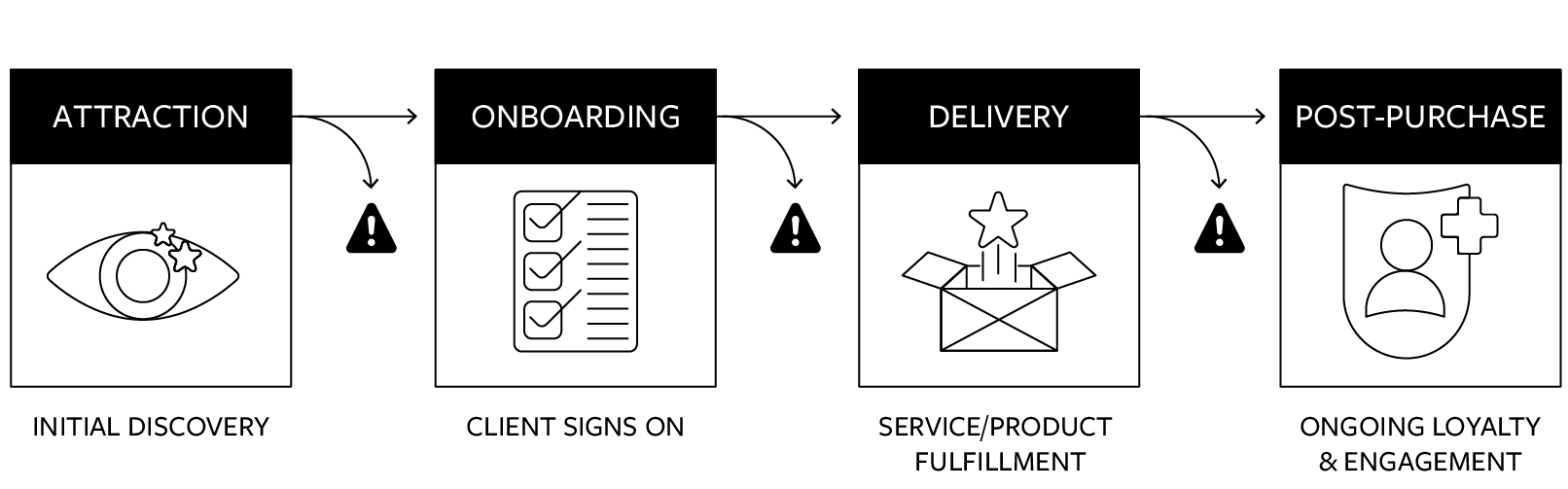
Phase 1: Attraction
This is that vital first impression. It's where potential clients find you and decide if you're worth their time. Success here means making sure your marketing matches the actual reality of your website and how you talk.
Examples of Poor Touchpoint Experiences
Hidden Information: You promise a specific solution or outcome in your ads, but the website content is just a generic "About Us" page rather than the specific product info they expected.
Inconsistent Tone: If your physical office space, or how you present yourself to clients in a meeting, or even the way your staff communicates doesn't consistently reflect your brand message, it creates a disconnect that damages trust.
Lack of Social Proof: Failing to display testimonials or case studies reduces the immediate credibility needed to convert a curious visitor.
Broken Links: The link in your social media bio leads to an error page.
The Ghost Period: Taking longer than 48 hours to reply to an inquiry.
Confusing Navigation: Visitors cannot quickly use or find your services.
Missing Call-to-Action: Your work looks great but do not tell the reader how to hire you.
Form Fatigue: The contact form asks for too much information before a relationship is built.
Easy Fix
Regularly audit all digital and human touchpoints to ensure they mirror your brand promise. This includes streamlining your website and contact forms for ease of use, as well as briefing your team to ensure your tone, professionalism, and environment are consistent with your visual identity.
Phase 2: Onboarding
Once a client decides to move forward, this is the 'handshake' phase—where you turn interest into a real partnership. It’s about making the paperwork feel as smooth and easy as the promise you made during the attraction phase.
Examples of Poor Touchpoint Experiences
Paperwork: Requiring a client to read through a heavy document and then print, physically sign, and scan back a contract.
Payment Trouble: An inflexible payment system that will not accept credit cards or has confusing bank transfer instructions.
Duplication: Asking the client to fill in information that you already have.
Unclear Next Steps: The proposal is accepted, but the client does not know exactly what needs to happen next or when they can expect to hear back.
Hidden Terms & Conditions: Burying key info in the contract without mentioning them verbally.
Easy Fix
Create a clear and concise introduction packaging in one branded email that contains the proposal and contracts. This ensures your operational efficiency and admin systems feel as polished and professional as your visual brand.
Phase 3: Delivery
This is where the actual product or service is handed to them. You’ll win here by keeping the client in the loop and making sure your delivery process is easy for them to follow, not just efficient for you.
Examples of Poor Touchpoint Experiences
Mixed Media Need: Some services or offerings need educational how-to videos and not just help pages or brochures.
The Endless Loop: A customer has an issue, reaches out, and is bounced from one department to another, having to explain their problem from scratch each time.
Radio Silence: Working without communication and leaving the client in the dark for weeks without project updates.
Disorganized Files: Sending links to a shared folder with no logical naming structure. Or sending documents without proper headings and formal structure.
Tone-Deaf Messaging: Using complex industry jargon that makes the reader feel lost when you are presenting deliverables.
Refusal to Adapt: Sticking strictly to a process which you are used to when it is not working.
Easy Fix
Implement a unified project management system that has templates for tracking status updates and client feedback. Setting company policies for document formatting and folder naming structures gets everyone on par with the requirements. Tools platforms such as Zapier or the AI built into modern project systems can also automate many of these file and folder creations to ensure compliance.
Phase 4: Post-Purchase
The final phase of brand touchpoints is often overlooked, but it is essential for long-term retention. It's all about leaving the client with a great lasting impression, so they’re excited to come back or tell their friends about you.
Examples of Poor Touchpoint Experiences
Assuming Clarity: Presuming the client knows exactly how to work with their product and not following up.
Blinded By Profit: Reaching out only when it is time to renew a contract or pay for a new license, rather than having a proactive conversation about their goals.
Easy Fix
Move beyond the final delivery by implementing a structured 'Success & Retention' workflow. Use platforms like Monday.com or Asana to trigger automated transition checklists, capture client feedback, and schedule proactive client check-ins. This turns project completion into a launchpad for future referrals and long-term partnerships.
What you can do
Brand Touchpoint Checklist
Audit Touchpoints:
Have you mapped every point where a client interacts with the company, from initial advert to final delivery?Consistency Check:
Does your internal communication tone, reception area, and digital interface reflect the visual brand promise?Friction Audit:
Are there any steps in our onboarding or delivery that require the client to do manual work, like printing/scanning or complex file navigation?Feedback Loop:
Do we have a system for capturing client feedback after delivery to ensure satisfaction and gather testimonials?Proactive Reach:
Is our post-purchase strategy focused on the client's ongoing goals, or only on contract renewal?
If your visual brand is strong but your operational systems feel disconnected, it is time to do a deeper analysis on the wider operations. We specialize in building creative infrastructure that aligns your digital identity with what your clients experience. Contact Haylett & Co today to schedule a comprehensive workflow audit and ensure your brand promise is delivered consistently from screen to stage.